SIMMS Flyweight Vibram Boots Review: Lightweight Stream-Fishing Boots
Yagichan
Yagichan’s Fishing & Travel Blog

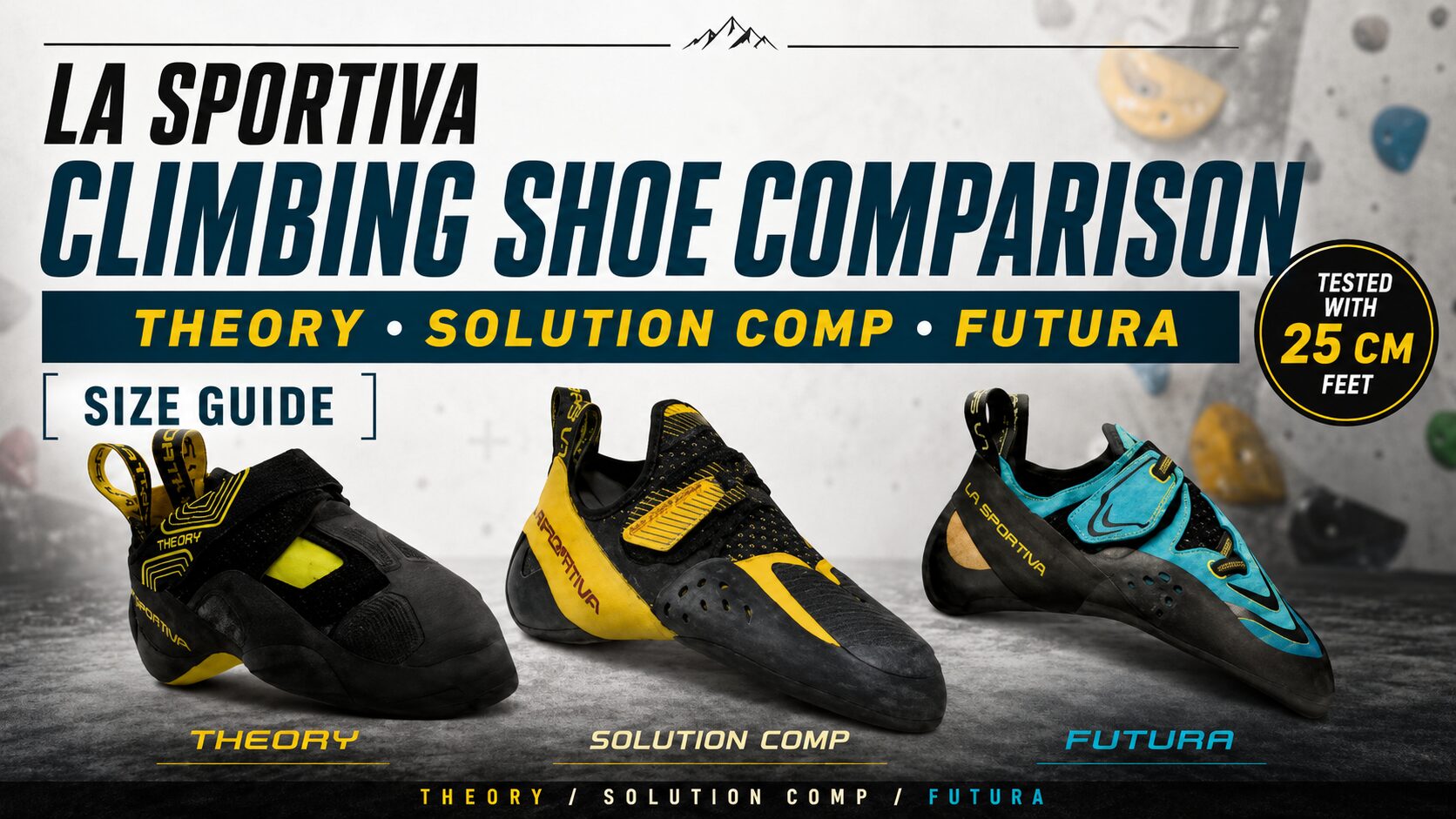

Which La Sportiva climbing shoe should you choose—and how far should you size down? My feet measure 25 cm (9.84 in), and I have climbed in the Theory, Solution Comp and Futura. Here is my honest comparison, including the EU sizes that worked for me.
| Model | Best for | My size (25 cm foot) | My short verdict |
|---|---|---|---|
| Theory | Modern indoor bouldering, volumes and sensitivity | EU 38 | Soft, adaptable and comfortable for performance climbing |
| Solution Comp | Steep terrain, toe hooks, heel hooks and precision | EU 38 | The most aggressive and secure of the three |
| Futura | Indoor and outdoor climbing with No-Edge sensitivity | EU 39 | My most versatile choice when foot feel matters |
If I had to reduce the comparison to one line: choose the Theory for soft indoor performance, the Solution Comp for steep and technical hooking, and the Futura for No-Edge sensitivity across both gym and rock.
My bare foot measures 25 cm from heel to longest toe. I chose EU 38 in both the Theory and Solution Comp, while EU 39 gave me the best balance of performance and comfort in the Futura.
| Model | My size | How it felt on my foot | What I would avoid |
|---|---|---|---|
| Theory | EU 38 | Close, soft and secure without excessive pain | Going so tight that the soft shoe loses its sensitivity to pain |
| Solution Comp | EU 38 | Aggressive but manageable, with strong heel security | Assuming its fit will match the original Solution |
| Futura | EU 39 | Slightly more forgiving, with better long-session usability | Choosing the smallest possible size simply because it is a performance shoe |
La Sportiva’s North American product pages state that the Theory is generally worn around 2–4 full EU sizes below standard EU street-shoe size, while the Solution Comp is often 1–3 EU sizes below. That guidance is broad and still depends heavily on the climber and foot shape. Measured foot length and an actual fitting are more useful than copying another person’s street-shoe conversion.
The table below combines specifications currently published by La Sportiva with clearly labeled personal observations. Product specifications can change by model year and region, so check the exact product page before buying.
| Feature | Theory | Solution Comp | Futura |
|---|---|---|---|
| Official weight | 215 g / 7.5 oz | 258 g / 8.9 oz | Not listed on the current global page |
| Outsole | Vibram XS Grip2, differentiated 1.9–4 mm | Vibram XS Grip2, 3.5 mm | Vibram XS Grip2, 3 mm |
| Construction | Hybrid No-Edge / D-Tech design | Traditional edge with P3 tensioning | No-Edge with P3 system |
| Closure | Single hook-and-loop strap | Fast Lacing and Lock Harness systems | Fast Lacing System |
| Official positioning | Modern competition climbing and volumes | Precision, competitions, bouldering and lead | Versatile No-Edge shoe for indoor and outdoor use |
The Theory is the softest, most volume-friendly option in this comparison. Its hybrid No-Edge construction and differentiated rubber thickness let the shoe spread and adapt to large modern holds while remaining sensitive underfoot.
I like how quickly it feels connected to the foot. The single strap makes it easy to remove between attempts, which is especially convenient during long gym sessions. Its PD 85 last is less aggressively asymmetric than the Solution Comp’s PD 75 last, and on my foot the Theory felt easier to live with while still delivering a performance fit.
The Solution Comp is the most aggressive shoe of the three. Its downturned, highly asymmetric shape concentrates power toward the big toe, while the extensive toe rubber and lower-profile heel make it particularly effective for toe hooks, heel hooks and steep bouldering.
Despite its aggressive shape, the Fast Lacing and Lock Harness systems allowed me to tune the fit securely. My EU 38 pair held the heel with very little movement. Compared with the Theory, the Solution Comp feels more directional and precise; compared with the Futura, it gives me a more familiar edge for small footholds.
The Futura’s defining feature is La Sportiva’s No-Edge construction. Without a conventional sharp edge around the toe, the shoe brings the foot closer to the climbing surface and spreads pressure more evenly. The result is an intuitive, sensitive feel—but climbers used to standing on a defined edge may need time to adapt.
I chose EU 39 rather than forcing my foot into the same EU 38 used for the other two models. That slightly less aggressive fit helped me use the Futura for both gym climbing and outdoor rock. After roughly two years of my own use, the shoe’s P3-supported downturned shape remained impressively consistent.
The Theory uses a hybrid design that incorporates No-Edge characteristics, while the Futura is a full No-Edge model. Both prioritize surface contact and sensitivity. The Solution Comp uses a more traditional defined edge, which can feel more familiar and supportive when placing the toe on a small foothold.
| No-Edge style | Traditional edge | |
|---|---|---|
| Feel | Close, sensitive and adaptable | Defined and easy to aim |
| Best impression | Volumes, smears and irregular surfaces | Small edges and precise toe placements |
| Learning curve | May take time if you rely on a sharp edge | More familiar to many climbers |
All three are performance-oriented shoes. A newer climber can wear them if the fit is appropriate, but they are not the easiest or most economical place to start. If you are still learning basic footwork and climbing mostly on beginner grades, a flatter and more comfortable shoe may provide better value while you discover your preferred climbing style.
Among these three, the Theory was the easiest for me to wear during repeated gym attempts, while the Futura offered the broadest indoor-to-outdoor range. The Solution Comp makes the most sense once you specifically want aggressive performance on steep terrain.
I wore EU 38 in the Theory and Solution Comp, and EU 39 in the Futura. This is only my personal reference point. Your ideal size can differ because of foot shape, climbing goals and desired comfort.
The Theory is my first choice for soft, modern volume-based gym climbing. The Solution Comp is stronger when steep terrain and powerful hooks dominate. The Futura works well indoors too, especially if you enjoy No-Edge sensitivity.
Of these three, the Futura has been my most versatile indoor-and-outdoor option. The best choice still depends on the rock and route: a more supportive traditional edge may be preferable on sustained tiny footholds.
A performance fit can feel tight and unfamiliar, but extreme pain is not a requirement. The shoe should hold the foot securely without sliding. If pain prevents you from weighting holds or climbing properly, the size or shape is probably wrong for you.
If you already know the model and size, online purchasing can be convenient. For a first pair in any of these models, trying them on is safer. Otherwise, choose a retailer that allows size exchanges and check whether worn climbing shoes remain returnable.
There is no single winner because the three shoes reward different styles. The Theory is my pick for soft indoor climbing, the Solution Comp for aggressive precision and hooking, and the Futura for versatile No-Edge sensitivity. More important than choosing the most advanced model is choosing the shape and size that let you climb well.
My measured 25 cm foot fit EU 38 in the Theory and Solution Comp and EU 39 in the Futura, but use those numbers as a starting point—not a prescription. The right shoe is the one that stays secure, supports your technique and lets you keep climbing.
Specification check: manufacturer pages were reviewed on July 16, 2026. Product specifications, availability and model construction may vary by country or model year. Personal sizing and durability comments are based on the author’s own pairs.